About the Journal
Scope of the Journal
Abstracting & Indexing
About the Journal
Archive
Author Instructions
Current issue
Editorial Board
JoMI Policy
JoMI Policy - A to C
JoMI Policy - D to L
JoMI Policy - O to T
Submit Manuscript
Updates
JoMI Updates 2026
JoMI Updates 2025
JoMI Updates 2027
Visit Us


LETTER TO THE EDITOR
Digital Health Integration in Obstetric Care: A Paradigm Shift Toward Equitable Maternal Health Outcomes
1
Obstetric and Gynecology, All India Institute of Medical Sciences (AIIMS), MIHAN, Nagpur, Maharashtra, 441108, India.
Submission date: 2026-05-01
Final revision date: 2026-07-11
Acceptance date: 2026-07-13
Online publication date: 2026-07-28
Publication date: 2026-07-28
Corresponding author
Amrita Singh
OBSTETRIC AND GYNECOLOGY, ALL INDIA INSTITUTE OF MEDICAL SCIENCES ,NAGPUR, 441108, NAGPUR, India
OBSTETRIC AND GYNECOLOGY, ALL INDIA INSTITUTE OF MEDICAL SCIENCES ,NAGPUR, 441108, NAGPUR, India
Journal of Medico Informatics 2026;02(Issue 03):1-3
HIGHLIGHTS
- Medical informatics can strengthen maternal healthcare delivery, particularly in resource-constrained settings.
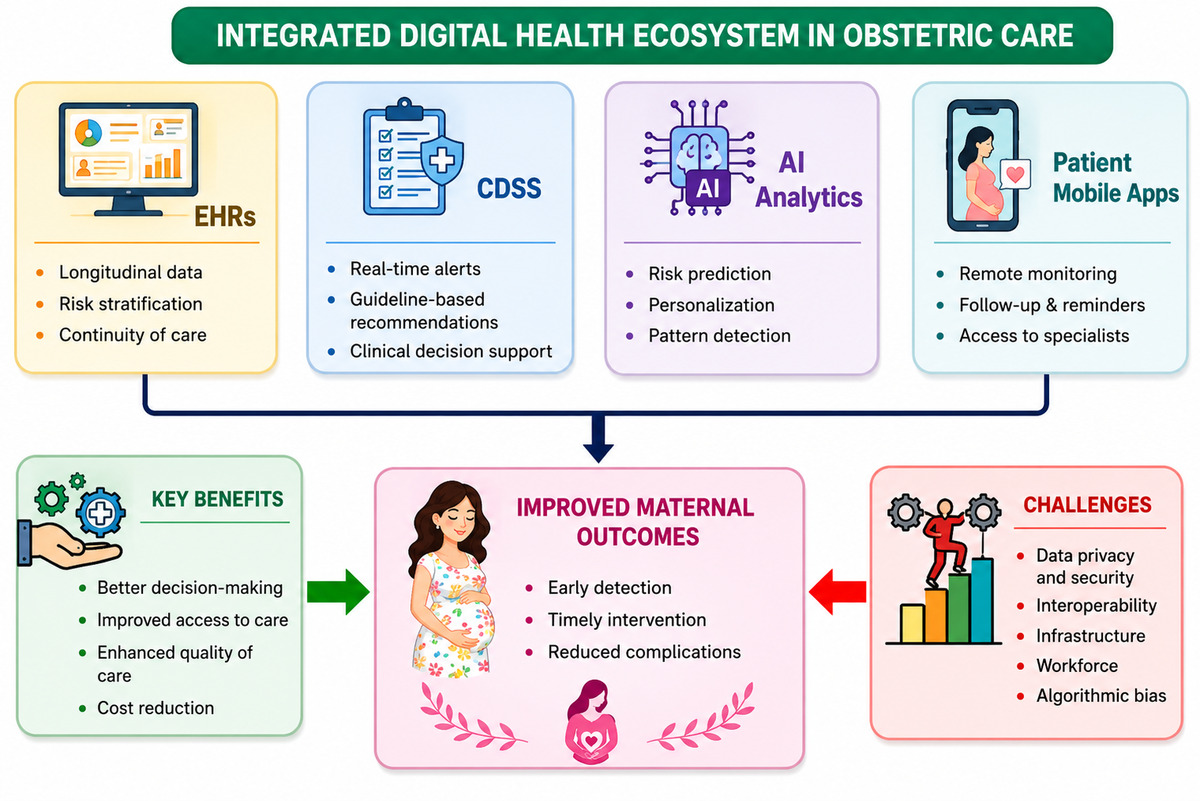
- Electronic health records (EHRs) enable longitudinal documentation, risk stratification, clinical alerts, and coordinated obstetric care.
- Clinical decision support systems (CDSS) can facilitate rapid, guideline-based decisions during obstetric emergencies and improve patient safety.
- AI-driven predictive analytics and telemedicine support early identification of high-risk pregnancies and expand access to specialized obstetric care.
- Successful implementation requires attention to data privacy, interoperability, infrastructure, algorithmic bias, training, and healthcare equity.
KEYWORDS
clinical decision support systemMaternal mortalityElectronic health recordsObsteteric careMedical informatics
TOPICS
ABSTRACT
Maternal mortality and morbidity remain major global health challenges, particularly in low- and middle-income countries (LMICs), where preventable conditions such as postpartum haemorrhage, hypertensive disorders of pregnancy, and puerperal sepsis account for a substantial proportion of maternal deaths. Despite the availability of evidence-based clinical guidelines, delays in diagnosis, fragmented care pathways, and limited access to specialized services continue to compromise maternal outcomes. Digital health technologies have emerged as promising tools to address these challenges and strengthen obstetric care delivery. Electronic health records (EHRs) facilitate longitudinal patient tracking, standardized documentation, risk stratification, and improved coordination across the continuum of maternal care. Clinical decision support systems (CDSS) provide real-time, guideline-based recommendations that enhance clinical decision-making during obstetric emergencies and reduce variability in care. Furthermore, advances in artificial intelligence (AI) and machine learning enable early prediction of high-risk conditions such as preeclampsia, gestational diabetes, and preterm birth, allowing timely interventions and more efficient allocation of healthcare resources. Telemedicine has expanded access to specialist consultations and follow-up services, particularly for women in rural settings, thereby improving continuity of care and reducing geographical barriers. The synergistic integration of these technologies creates a comprehensive digital ecosystem capable of enhancing maternal risk assessment, clinical management, and healthcare accessibility. However, challenges related to data privacy, interoperability, digital infrastructure, workforce training, must be addressed to ensure equitable implementation. Strategic investment in digital health infrastructure and governance frameworks can facilitate the effective adoption of these innovations, ultimately contributing to reduced maternal morbidity and mortality and improved maternal health.
ACKNOWLEDGEMENTS
The authors sincerely acknowledge the Department of Obstetrics and Gynecology, All India Institute of Medical Sciences (AIIMS), MIHAN, Nagpur, Maharashtra, India, for providing institutional support and facilities necessary to carry out this research. Their continued encouragement and assistance are gratefully appreciated.
FUNDING
This research received no external funding. All work was conducted using institutional resources without dedicated grant support.
CONFLICT OF INTEREST
The authors declare that they have no known financial, personal, academic, or other relationships that could inappropriately influence, or be perceived to influence, the work reported in this manuscript. All authors confirm that there are no competing interests to declare.
PEER REVIEW INFORMATION
Article has been screened for originality
© 2026 The Authors. Published by Aayvu Publications Private Limited under CC BY 4.0.
REFERENCES (8)
1.
Awoyemi T, Tolu-Akinnawo OZ, Mahtani A, Padda I, Ogunniyi KE, Bolakale-Rufai IK, Olusanya A, Dorcas AO, Amarachi CB, Akinmoju OD, Uche-Orji CI, Fattah M. (2025), Advancing cardio-obstetric care through digital health technologies: A narrative review, ESC Heart Fail, 12(6):4069-4085. doi:10.1002/ehf2.15426. PMID: 41178633.
2.
Bignell CA, Petrovskaya O. (2024), Understanding the role and impact of electronic health records in labor and delivery nursing practice: A scoping review protocol, Digit Health, 10:20552076241249271. doi:10.1177/20552076241249271. PMID: 38665885.
3.
Conduah AK, Ofoe S, Siaw-Marfo D. (2025), Data privacy in healthcare: Global challenges and solutions, Digit Health, 11:20552076251343959. doi:10.1177/20552076251343959. PMID: 40475296.
4.
Demissie DB, Kaura DK, Gebhardt S. (2025), Global burden, disparities, and determinants of postpartum haemorrhage among women who gave birth: an umbrella review of systematic reviews and meta-analyses, Front Reprod Health, 7:1721550. doi:10.3389/frph.2025.1721550. PMID: 41487297.
5.
Khan SN, Danishuddin, Khan MWA, Guarnera L, Akhtar SMF. (2025), Multi-modal AI in precision medicine: integrating genomics, imaging, and EHR data for clinical insights, Front Artif Intell, 8:1743921. doi:10.3389/frai.2025.1743921. PMID: 41573270.
6.
Lawrence ER, Klein TJ, Beyuo TK. (2022), Maternal Mortality in Low and Middle-Income Countries, Obstet Gynecol Clin North Am, 49(4):713-733. doi:10.1016/j.ogc.2022.07.001. PMID: 36328676.
7.
Makhni S, Cerrato P, Rico J, Niazi S, O'Horo J, Peters S, Shah V, Halamka J. (2025), Meeting the challenges of electronic health record (EHR) optimization, NPJ Digit Med, 9(1):8. doi:10.1038/s41746-025-02178-w. PMID: 41413263.
8.
Medani IE, Hakami AM, Chourasia UH, Rahamtalla B, Adawi NM, Fadailu M, Salih A, Abdelmola A, Hashim KN, Dawelbait AM, Yousf NM, Hassan NM, Ali NA, Rizig AA. (2025), Telemedicine in Obstetrics and Gynecology: A Scoping Review of Enhancing Access and Outcomes in Modern Healthcare, Healthcare (Basel), 13(16) doi:10.3390/healthcare13162036. PMID: 40868652.
| ISSN: | 3108-2696 |

We process personal data collected when visiting the website. The function of obtaining information about users and their behavior is carried out by voluntarily entered information in forms and saving cookies in end devices. Data, including cookies, are used to provide services, improve the user experience and to analyze the traffic in accordance with the Privacy policy. Data are also collected and processed by Google Analytics tool (more).
You can change cookies settings in your browser. Restricted use of cookies in the browser configuration may affect some functionalities of the website.
You can change cookies settings in your browser. Restricted use of cookies in the browser configuration may affect some functionalities of the website.