About the Journal
Scope of the Journal
Indexed In
Journal Information
Archive
Author Instructions
Current issue
Editorial Board
Journal Policy
AI Policy
APC Policy
Authorship Policy
Author Recognition Policy
Citation Policy
Conflict of Interest (COI) Policy
Copyright Policy
Data Availability Policy
DEI Policy
Digital Archiving Policy
Ethical Approval Policy
Funding Policy
Image Policy
Open Access Policy
Ownership & Governance
Peer Review Policy
Personal Data Protection Policy
Plagiarism Policy
Post-Publication Policy
Preprint Policy
Submit Manuscript
Contact
Journal Policy
AI Policy
APC Policy
Authorship Policy
Author Recognition Policy
Citation Policy
Conflict of Interest (COI) Policy
Copyright Policy
Data Availability Policy
DEI Policy
Digital Archiving Policy
Ethical Approval Policy
Funding Policy
Image Policy
Open Access Policy
Ownership & Governance
Peer Review Policy
Personal Data Protection Policy
Plagiarism Policy
Post-Publication Policy
Preprint Policy


RESEARCH PAPER
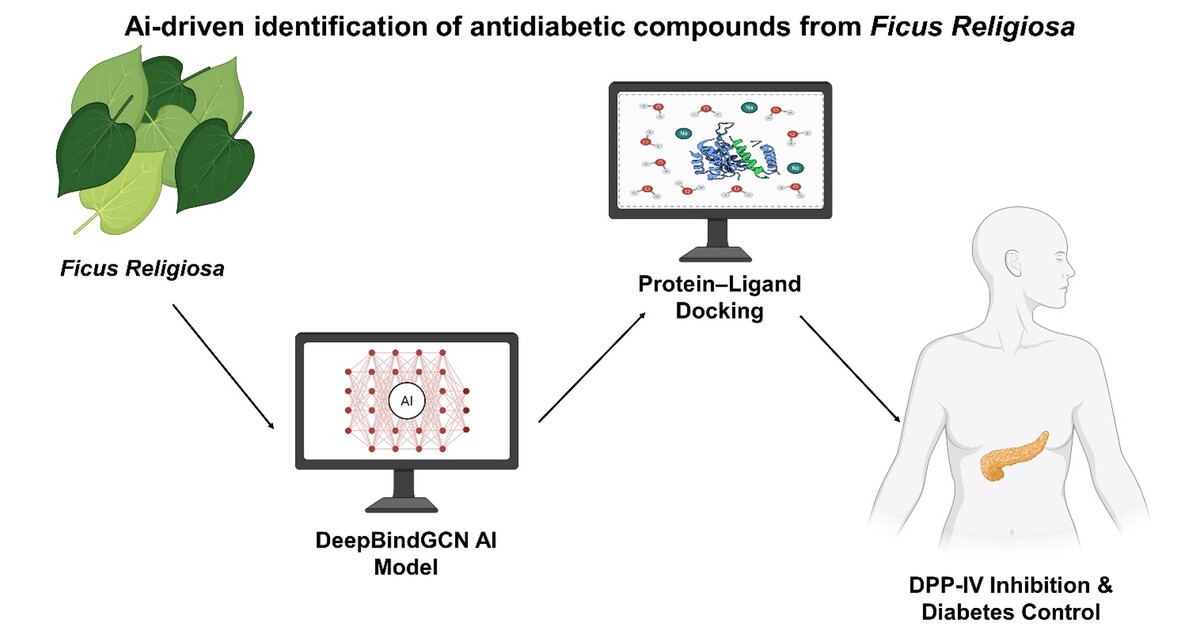
Artificial Intelligence Powered Identification of Potential Antidiabetic Compounds in Ficus religiosa
1
Ochsner Center for Outcomes Research, Ochsner Research, Ochsner Clinic Foundation, New Orleans, LA 70121, USA, United States
2
Department of Ophthalmology, Wilmer Eye Institute, Johns Hopkins University
School of Medicine, Baltimore, MD 21287, USA, United States
Submission date: 2025-09-04
Final revision date: 2025-10-16
Acceptance date: 2026-01-20
Online publication date: 2026-04-28
Publication date: 2026-04-28
Corresponding author
Ashad Alam
Ochsner Center for Outcomes Research, Ochsner Research, Ochsner Clinic Foundation, New Orleans, LA 70121, USA
Ochsner Center for Outcomes Research, Ochsner Research, Ochsner Clinic Foundation, New Orleans, LA 70121, USA
Journal of Medico Informatics 2026;02(Issue 02):42-51
HIGHLIGHTS
- AI accelerates discovery of antidiabetic phytochemicals from Ficus religiosa.
- Bergenin and caffeic acid show strong DPP-IV inhibitory binding affinity.
- DeepBindGCN improves prediction of ligand–protein binding interactions.
- ADMET profiling confirms favorable pharmacokinetics and low toxicity.
- AI-driven screening reduces time and cost in drug discovery.
KEYWORDS
TOPICS
ABSTRACT
Diabetes mellitus is a chronic metabolic disorder that necessitates novel therapeutic innovations due to its gradual progression and the onset of various metabolic complications. Research indicates that Ficus religiosa is a conventional medicinal plant that generates bioactive phytochemicals with potential antidiabetic properties. The investigation employs ecosystem-based computational approaches utilizing artificial intelligence to investigate and evaluate compounds derived from Ficus religiosa that exhibit antidiabetic properties. A comprehensive computational procedure incorporated machine learning methodologies, molecular docking techniques, and ADMET prediction systems to assess phytochemical efficacy against the significant antidiabetic enzyme dipeptidyl peptidase-4 (DPP-4). DeepBindGCN and the AutoDock software facilitated the investigation of binding interactions via deep learning technology. Flavonoids and alkaloids have emerged as attractive phytochemicals due to their strong binding interactions and advantageous pharmacological effects, as indicated by the study. The introduction of AI accelerated screening procedures and enhanced accuracy rates, demonstrating its efficacy in researching plant-based antidiabetic agents. The scientific foundation now facilitates future experimental validation of natural product therapies tailored for diabetic management.
ABBREVIATIONS
AI – Artificial Intelligence
T2DM – Type 2 Diabetes Mellitus
DPP-IV – Dipeptidyl Peptidase IV
GLP-1 – Glucagon-Like Peptide-1
GIP – Glucose-Dependent Insulinotropic Polypeptide
ADMET – Absorption, Distribution, Metabolism, Excretion, Toxicity
CNN – Convolutional Neural Network
RNN – Recurrent Neural Network
GNN – Graph Neural Network
VAE – Variational Autoencoder
GAN – Generative Adversarial Network
MM/PBSA – Molecular Mechanics/Poisson–Boltzmann Surface Area
PDB – Protein Data Bank
SDF – Structure Data File
TPSA – Topological Polar Surface Area
ACKNOWLEDGEMENTS
The authors gratefully acknowledge the Ochsner Center for Outcomes Research, Ochsner Research, Ochsner Clinic Foundation, New Orleans, LA 70121, USA, for providing the necessary facilities to carry out this study. The authors also extend their sincere thanks to the Wilmer Eye Institute, Johns Hopkins University School of Medicine, Baltimore, MD 21287, USA, for their support and provision of essential resources to complete this work.
FUNDING
This research received no external funding. All work was conducted using institutional resources without dedicated grant support.
CONFLICT OF INTEREST
The authors declare that they have no known financial, personal, academic, or other relationships that could inappropriately influence, or be perceived to influence, the work reported in this manuscript. All authors confirm that there are no competing interests to declare.
PEER REVIEW INFORMATION
Article has been screened for originality
© 2026 The Authors. Published by Aayvu Publications Private Limited under CC BY 4.0.
REFERENCES (50)
1.
Aertgeerts K, Ye S, Tennant MG, Kraus ML, Rogers J, Sang BC, Skene RJ, Webb DR, Prasad GS. (2004), Crystal structure of human dipeptidyl peptidase IV in complex with a decapeptide reveals details on substrate specificity and tetrahedral intermediate formation, Protein Sci, 13(2):412-21. doi:10.1110/ps.03460604. PMID: 14718659.
2.
Agyapong O, Asiedu SO, Kwofie SK, Miller WA, 3rd, Parry CS, Sowah RA, Wilson MD. (2021), Molecular modelling and de novo fragment-based design of potential inhibitors of beta-tubulin gene of Necator americanus from natural products, Inform Med Unlocked, 26 doi:10.1016/j.imu.2021.100734. PMID: 34912942.
3.
Alam S, Sarker MMR, Sultana TN, Chowdhury MNR, Rashid MA, Chaity NI, Zhao C, Xiao J, Hafez EE, Khan SA, Mohamed IN. (2022), Antidiabetic Phytochemicals From Medicinal Plants: Prospective Candidates for New Drug Discovery and Development, Front Endocrinol (Lausanne), 13:800714. doi:10.3389/fendo.2022.800714. PMID: 35282429.
4.
Amorim AMB, Piochi LF, Gaspar AT, Preto AJ, Rosario-Ferreira N, Moreira IS. (2024), Advancing Drug Safety in Drug Development: Bridging Computational Predictions for Enhanced Toxicity Prediction, Chem Res Toxicol, 37(6):827-849. doi:10.1021/acs.chemrestox.3c00352. PMID: 38758610.
5.
Ashalatha KL, Arunkumar KP, Gowda M. (2023), Genomic and transcriptomic analysis of sacred fig (Ficus religiosa), BMC Genomics, 24(1):197. doi:10.1186/s12864-023-09270-z. PMID: 37046210.
6.
Ashraf K, Haque MR, Amir M, Ahmad N, Ahmad W, Sultan S, Ali Shah SA, Mahmoud Alafeefy A, Mujeeb M, Bin Shafie MF. (2021), An Overview of Phytochemical and Biological Activities: Ficus deltoidea Jack and Other Ficus spp, J Pharm Bioallied Sci, 13(1):11-25. doi:10.4103/jpbs.JPBS_232_19. PMID: 34084044.
7.
Basile AO, Yahi A, Tatonetti NP. (2019), Artificial Intelligence for Drug Toxicity and Safety, Trends Pharmacol Sci, 40(9):624-635. doi:10.1016/j.tips.2019.07.005. PMID: 31383376.
8.
Bayanati M, Ismail Mahboubi Rabbani M, Sirous Kabiri S, Mir B, Rezaee E, Tabatabai SA. (2024), Dipeptidyl Peptidase-4 Inhibitors: A Systematic Review of Structure-Activity Relationship Studies, Iran J Pharm Res, 23(1):e151581. doi:10.5812/ijpr-151581. PMID: 40066124.
9.
Boer GA, Holst JJ. (2020), Incretin Hormones and Type 2 Diabetes-Mechanistic Insights and Therapeutic Approaches, Biology (Basel), 9(12) doi:10.3390/biology9120473. PMID: 33339298.
10.
Carpenter KA, Huang X. (2018), Machine Learning-based Virtual Screening and Its Applications to Alzheimer's Drug Discovery: A Review, Curr Pharm Des, 24(28):3347-3358. doi:10.2174/1381612824666180607124038. PMID: 29879881.
11.
Chakraborty C, Bhattacharya M, Lee SS, Wen ZH, Lo YH. (2024), The changing scenario of drug discovery using AI to deep learning: Recent advancement, success stories, collaborations, and challenges, Mol Ther Nucleic Acids, 35(3):102295. doi:10.1016/j.omtn.2024.102295. PMID: 39257717.
12.
Chandrasekar SB, Bhanumathy M, Pawar AT, Somasundaram T. (2010), Phytopharmacology of Ficus religiosa, Pharmacogn Rev, 4(8):195-9. doi:10.4103/0973-7847.70918. PMID: 22228961.
13.
Chang Y, Hawkins BA, Du JJ, Groundwater PW, Hibbs DE, Lai F. (2022), A Guide to In Silico Drug Design, Pharmaceutics, 15(1) doi:10.3390/pharmaceutics15010049. PMID: 36678678.
14.
Chaudhary A, Yadav BS, Singh S, Maurya PK, Mishra A, Srivastva S, Varadwaj PK, Singh NK, Mani A. (2017), Docking-based Screening of Ficus religiosa Phytochemicals as Inhibitors of Human Histamine H2 Receptor, Pharmacogn Mag, 13(Suppl 3):S706-S714. doi:10.4103/pm.pm_49_17. PMID: 29142437.
15.
Chaudhury A, Duvoor C, Reddy Dendi VS, Kraleti S, Chada A, Ravilla R, Marco A, Shekhawat NS, Montales MT, Kuriakose K, Sasapu A, Beebe A, Patil N, Musham CK, Lohani GP, Mirza W. (2017), Clinical Review of Antidiabetic Drugs: Implications for Type 2 Diabetes Mellitus Management, Front Endocrinol (Lausanne), 8:6. doi:10.3389/fendo.2017.00006. PMID: 28167928.
16.
Chen SY, Zacharias M. (2022), An internal docking site stabilizes substrate binding to gamma-secretase: Analysis by molecular dynamics simulations, Biophys J, 121(12):2330-2344. doi:10.1016/j.bpj.2022.05.023. PMID: 35598043.
17.
Chen W, Liu X, Zhang S, Chen S. (2023), Artificial intelligence for drug discovery: Resources, methods, and applications, Mol Ther Nucleic Acids, 31:691-702. doi:10.1016/j.omtn.2023.02.019. PMID: 36923950.
18.
Chen Z, Su X, Cao W, Tan M, Zhu G, Gao J, Zhou L. (2024), The Discovery and Characterization of a Potent DPP-IV Inhibitory Peptide from Oysters for the Treatment of Type 2 Diabetes Based on Computational and Experimental Studies, Mar Drugs, 22(8) doi:10.3390/md22080361. PMID: 39195477.
19.
Chhabria S, Mathur S, Vadakan S, Sahoo DK, Mishra P, Paital B. (2022), A review on phytochemical and pharmacological facets of tropical ethnomedicinal plants as reformed DPP-IV inhibitors to regulate incretin activity, Front Endocrinol (Lausanne), 13:1027237. doi:10.3389/fendo.2022.1027237. PMID: 36440220.
20.
Chihomvu P, Ganesan A, Gibbons S, Woollard K, Hayes MA. (2024), Phytochemicals in Drug Discovery-A Confluence of Tradition and Innovation, Int J Mol Sci, 25(16) doi:10.3390/ijms25168792. PMID: 39201478.
21.
Chikhale RV, Choudhary R, Eldesoky GE, Kolpe MS, Shinde O, Hossain D. (2025), Generative AI, molecular docking and molecular dynamics simulations assisted identification of novel transcriptional repressor EthR inhibitors to target Mycobacterium tuberculosis, Heliyon, 11(4):e42593. doi:10.1016/j.heliyon.2025.e42593. PMID: 40034280.
22.
Galicia-Garcia U, Benito-Vicente A, Jebari S, Larrea-Sebal A, Siddiqi H, Uribe KB, Ostolaza H, Martin C. (2020), Pathophysiology of Type 2 Diabetes Mellitus, Int J Mol Sci, 21(17) doi:10.3390/ijms21176275. PMID: 32872570.
23.
Gangwal A, Ansari A, Ahmad I, Azad AK, Kumarasamy V, Subramaniyan V, Wong LS. (2024), Generative artificial intelligence in drug discovery: basic framework, recent advances, challenges, and opportunities, Front Pharmacol, 15:1331062. doi:10.3389/fphar.2024.1331062. PMID: 38384298.
24.
Garg P, Singhal G, Kulkarni P, Horne D, Salgia R, Singhal SS. (2024), Artificial Intelligence-Driven Computational Approaches in the Development of Anticancer Drugs, Cancers (Basel), 16(22) doi:10.3390/cancers16223884. PMID: 39594838.
25.
Hossain MJ, Al-Mamun M, Islam MR. (2024), Diabetes mellitus, the fastest growing global public health concern: Early detection should be focused, Health Sci Rep, 7(3):e2004. doi:10.1002/hsr2.2004. PMID: 38524769.
26.
Hossain MU, Rahman A, Hossain MS, Dey S, Chowdhury ZM, Bhattacharjee A, Ahammad I, Hasan MK, Ahmed I, Hosen MB, Das KC, Keya CA, Salimullah M. (2025), Harnessing animal model and computational experiments to discover antidiabetic compounds in Ficus racemosa, BMC Complement Med Ther, 25(1):215. doi:10.1186/s12906-025-04845-7. PMID: 40604816.
27.
Kim S, Thiessen PA, Bolton EE, Chen J, Fu G, Gindulyte A, Han L, He J, He S, Shoemaker BA, Wang J, Yu B, Zhang J, Bryant SH. (2016), PubChem Substance and Compound databases, Nucleic Acids Res, 44(D1):D1202-13. doi:10.1093/nar/gkv951. PMID: 26400175.
28.
Kim YG, Kim S, Han SJ, Kim DJ, Lee KW, Kim HJ. (2018), Dipeptidyl Peptidase-4 Inhibitors and the Risk of Pancreatitis in Patients with Type 2 Diabetes Mellitus: A Population-Based Cohort Study, J Diabetes Res, 2018:5246976. doi:10.1155/2018/5246976. PMID: 29850606.
29.
Kraljevic S, Stambrook PJ, Pavelic K. (2004), Accelerating drug discovery, EMBO Rep, 5(9):837-42. doi:10.1038/sj.embor.7400236. PMID: 15470377.
30.
Kumar A, Gangwar R, Zargar AA, Kumar R, Sharma A. (2024), Prevalence of Diabetes in India: A Review of IDF Diabetes Atlas 10th Edition, Curr Diabetes Rev, 20(1):e130423215752. doi:10.2174/1573399819666230413094200. PMID: 37069712.
31.
Kumar A, P N, Kumar M, Jose A, Tomer V, Oz E, Proestos C, Zeng M, Elobeid T, K S, Oz F. (2023), Major Phytochemicals: Recent Advances in Health Benefits and Extraction Method, Molecules, 28(2) doi:10.3390/molecules28020887. PMID: 36677944.
32.
Li Y, Fan Z, Rao J, Chen Z, Chu Q, Zheng M, Li X. (2023), An overview of recent advances and challenges in predicting compound-protein interaction (CPI), Med Rev (2021), 3(6):465-486. doi:10.1515/mr-2023-0030. PMID: 38282802.
33.
Mohanraj K, Karthikeyan BS, Vivek-Ananth RP, Chand RPB, Aparna SR, Mangalapandi P, Samal A. (2018), IMPPAT: A curated database of Indian Medicinal Plants, Phytochemistry And Therapeutics, Sci Rep, 8(1):4329. doi:10.1038/s41598-018-22631-z. PMID: 29531263.
34.
Mulvihill EE, Drucker DJ. (2014), Pharmacology, physiology, and mechanisms of action of dipeptidyl peptidase-4 inhibitors, Endocr Rev, 35(6):992-1019. doi:10.1210/er.2014-1035. PMID: 25216328.
35.
Niazi SK, Mariam Z. (2025), Artificial intelligence in drug development: reshaping the therapeutic landscape, Ther Adv Drug Saf, 16:20420986251321704. doi:10.1177/20420986251321704. PMID: 40008227.
36.
Noor F, Tahir Ul Qamar M, Ashfaq UA, Albutti A, Alwashmi ASS, Aljasir MA. (2022), Network Pharmacology Approach for Medicinal Plants: Review and Assessment, Pharmaceuticals (Basel), 15(5) doi:10.3390/ph15050572. PMID: 35631398.
37.
Ocana A, Pandiella A, Privat C, Bravo I, Luengo-Oroz M, Amir E, Gyorffy B. (2025), Integrating artificial intelligence in drug discovery and early drug development: a transformative approach, Biomark Res, 13(1):45. doi:10.1186/s40364-025-00758-2. PMID: 40087789.
38.
Odeyemi S, Bradley G. (2018), Medicinal Plants Used for the Traditional Management of Diabetes in the Eastern Cape, South Africa: Pharmacology and Toxicology, Molecules, 23(11) doi:10.3390/molecules23112759. PMID: 30366359.
39.
Paul D, Sanap G, Shenoy S, Kalyane D, Kalia K, Tekade RK. (2021), Artificial intelligence in drug discovery and development, Drug Discov Today, 26(1):80-93. doi:10.1016/j.drudis.2020.10.010. PMID: 33099022.
40.
Rawat R, Kumar H, Singh N, Deep A, Narasimhan B, Singh Yadav S, Kumar S. (2024), Comprehensive review on ethnomedicinal, phytochemistry and pharmacological profile of, J Tradit Chin Med, 44(5):1052-1057. doi:10.19852/j.cnki.jtcm.2024.05.012. PMID: 39380237.
41.
Saini K, Sharma S, Khan Y. (2023), DPP-4 inhibitors for treating T2DM - hype or hope? an analysis based on the current literature, Front Mol Biosci, 10:1130625. doi:10.3389/fmolb.2023.1130625. PMID: 37287751.
42.
Serrano DR, Luciano FC, Anaya BJ, Ongoren B, Kara A, Molina G, Ramirez BI, Sanchez-Guirales SA, Simon JA, Tomietto G, Rapti C, Ruiz HK, Rawat S, Kumar D, Lalatsa A. (2024), Artificial Intelligence (AI) Applications in Drug Discovery and Drug Delivery: Revolutionizing Personalized Medicine, Pharmaceutics, 16(10) doi:10.3390/pharmaceutics16101328. PMID: 39458657.
43.
Tran N, Pham B, Le L. (2020), Bioactive Compounds in Anti-Diabetic Plants: From Herbal Medicine to Modern Drug Discovery, Biology (Basel), 9(9) doi:10.3390/biology9090252. PMID: 32872226.
44.
Trott O, Olson AJ. (2010), AutoDock Vina: improving the speed and accuracy of docking with a new scoring function, efficient optimization, and multithreading, J Comput Chem, 31(2):455-61. doi:10.1002/jcc.21334. PMID: 19499576.
45.
Vora LK, Gholap AD, Jetha K, Thakur RRS, Solanki HK, Chavda VP. (2023), Artificial Intelligence in Pharmaceutical Technology and Drug Delivery Design, Pharmaceutics, 15(7) doi:10.3390/pharmaceutics15071916. PMID: 37514102.
46.
Weiss R, Karimijafarbigloo S, Roggenbuck D, Rodiger S. (2022), Applications of Neural Networks in Biomedical Data Analysis, Biomedicines, 10(7) doi:10.3390/biomedicines10071469. PMID: 35884772.
47.
Wu F, Zhou Y, Li L, Shen X, Chen G, Wang X, Liang X, Tan M, Huang Z. (2020), Computational Approaches in Preclinical Studies on Drug Discovery and Development, Front Chem, 8:726. doi:10.3389/fchem.2020.00726. PMID: 33062633.
48.
Xiong G, Wu Z, Yi J, Fu L, Yang Z, Hsieh C, Yin M, Zeng X, Wu C, Lu A, Chen X, Hou T, Cao D. (2021), ADMETlab 2.0: an integrated online platform for accurate and comprehensive predictions of ADMET properties, Nucleic Acids Res, 49(W1):W5-W14. doi:10.1093/nar/gkab255. PMID: 33893803.
49.
Yin R, Xu Y, Wang X, Yang L, Zhao D. (2022), Role of Dipeptidyl Peptidase 4 Inhibitors in Antidiabetic Treatment, Molecules, 27(10) doi:10.3390/molecules27103055. PMID: 35630534.
50.
Zhang H, Saravanan KM, Zhang JZH. (2023), DeepBindGCN: Integrating Molecular Vector Representation with Graph Convolutional Neural Networks for Protein-Ligand Interaction Prediction, Molecules, 28(12) doi:10.3390/molecules28124691. PMID: 37375246.
| ISSN: | 3108-2696 |

We process personal data collected when visiting the website. The function of obtaining information about users and their behavior is carried out by voluntarily entered information in forms and saving cookies in end devices. Data, including cookies, are used to provide services, improve the user experience and to analyze the traffic in accordance with the Privacy policy. Data are also collected and processed by Google Analytics tool (more).
You can change cookies settings in your browser. Restricted use of cookies in the browser configuration may affect some functionalities of the website.
You can change cookies settings in your browser. Restricted use of cookies in the browser configuration may affect some functionalities of the website.
