About the Journal
Scope of the Journal
Indexed In
Journal Information
Current issue
Archive
Editorial Board
Journal Policy
APC Policy
Authorship Policy
Author Recognition Policy
Citation Policy
Conflict of Interest (COI) Policy
Copyright Policy
Data Availability Policy
DEI Policy
Digital Archiving Policy
Ethical Approval Policy
Funding Policy
Image Policy
Open Access Policy
Ownership & Governance
Peer Review Policy
Personal Data Protection Policy
Plagiarism Policy
Post-Publication Policy
Preprint Policy
Author Instructions
Submit Manuscript
Contact Information
Journal Policy
APC Policy
Authorship Policy
Author Recognition Policy
Citation Policy
Conflict of Interest (COI) Policy
Copyright Policy
Data Availability Policy
DEI Policy
Digital Archiving Policy
Ethical Approval Policy
Funding Policy
Image Policy
Open Access Policy
Ownership & Governance
Peer Review Policy
Personal Data Protection Policy
Plagiarism Policy
Post-Publication Policy
Preprint Policy


RESEARCH PAPER
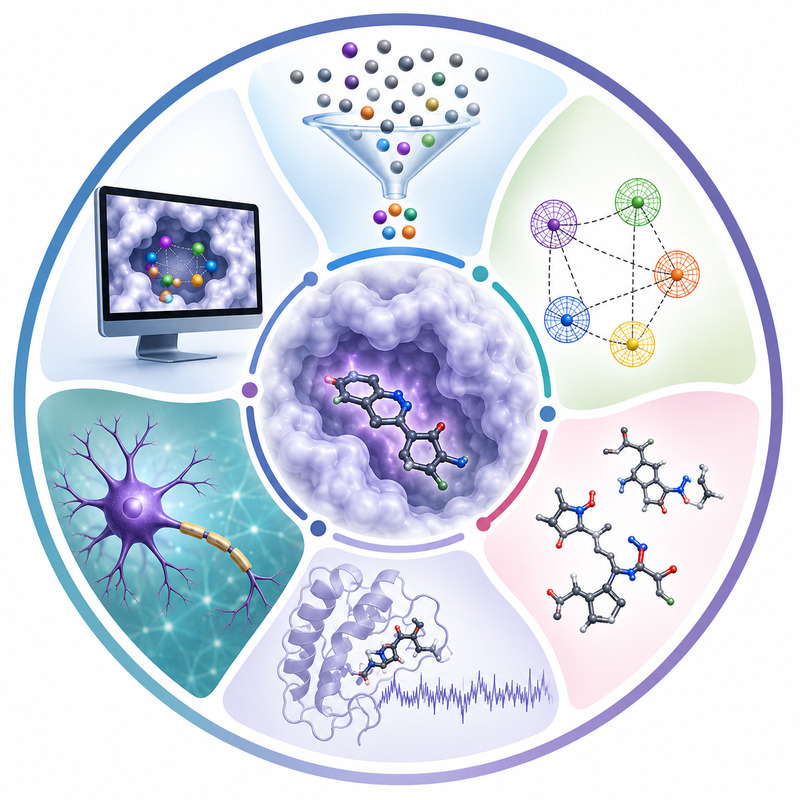
Pharmacophore-Guided Discovery of a Novel Monoamine Oxidase A Inhibitor for Diabetic Neuropathy Using Virtual Screening, Molecular Docking, and Molecular Dynamics Simulations.
1
Department of Bioinformatics, Bharathiar University, Coimbatore, Tamil Nadu, India
Submission date: 2026-04-05
Final revision date: 2026-05-30
Acceptance date: 2026-06-16
Online publication date: 2026-07-28
Publication date: 2026-07-28
Journal of Medico Informatics 2026;02(Issue 03):40-48
HIGHLIGHTS
- Integrated pharmacophore screening identified promising MAO-A inhibitors for neuropathy research.
- Five-feature AAHRR pharmacophore captured essential characteristics of MAO-A binding sites.
- Approximately 1,000 ZINC compounds passed pharmacophore and drug-likeness screening criteria.
- ZINC02123682 achieved strongest docking score, interacting with key MAO-A residues.
- One-nanosecond dynamics showed stable complex behavior, supporting further experimental validation.
KEYWORDS
Diabetic NeuropathyMolecular DockingMolecular Dynamics SimulationMonoamine Oxidase A (MAO-A)Pharmacophore Modeling
TOPICS
ABSTRACT
Diabetic Neuropathy (DN) is a severe diabetes complication linked to progressive peripheral nerve degeneration, oxidative stress, mitochondrial dysfunction and chronic neuropathic pain with no effective disease-modifying therapies available to date. Due to the key role of MAO-A in monoamine metabolism and reactive oxygen species production, its inhibition may help reduce oxidative stress–related neuronal damage in diabetic neuropathy. This study used a computational drug discovery approach targeting MAO-A. Ligand-based pharmacophore modeling was performed using 52 caffeine derivatives from the literature to create a dataset for energetic evaluation and identify new MAO-A inhibitors. A five-feature AAHRR hypothesis comprising two hydrogen bond acceptors, one hydrophobic and two aromatic rings was generated using the PHASE 3.0 module. A series of these 1,000 drug-like compounds were then retrieved by screening the ZINC database with validated pharmacophore model. They underwent molecular docking and high-throughput virtual screening against the human MAO-A crystal structure (PDB ID: 2Z5X). Among 591 compounds with appropriate binding profiles, the top ranked compound based on Glide G score was ZINC02123682 [(1r,4r)-4-((2-(5,7-dimethoxy-4-methyl-2-oxo-2H-chromen–3–yl)acetamido)methyl)cyclohexanecarboxylic acid] (Glide G-score = −7.54). The stability of the protein–ligand complex was additionally validated by 1000-ps molecular dynamics simulations in explicit TIP3P water environment using the OPLS_2005 force field, with stable RMSD fluctuations maintained within 2-4 Å and a favourable negative potential energy profile through the period of simulation. These data characterize ZINC02123682 as a structurally optimized and dynamically stable MAO-A inhibitor, providing an attractive lead compound in the development of potential new neuroprotective therapeutics for diabetic neuropathy.
ABBREVIATIONS
DN – Diabetic Neuropathy
MAO-A – Monoamine Oxidase A
MAO-B – Monoamine Oxidase B
ROS – Reactive Oxygen Species
FAD – Flavin Adenine Dinucleotide
5-HT – 5-Hydroxytryptamine
PDB – Protein Data Bank
AAHRR – Two Hydrogen-Bond Acceptors, One Hydrophobic Feature, Two Aromatic Rings
HBA – Hydrogen Bond Acceptor
HBD – Hydrogen Bond Donor
pIC50 – Negative Logarithm of IC50
IC50 – Half-Maximal Inhibitory Concentration
PHASE – Pharmacophore Identification and Searching
RMSD – Root Mean Square Deviation
VMS – Vector Match Selectivity
HTVS – High-Throughput Virtual Screening
MD – Molecular Dynamics
TIP3P – Three-Point Transferable Intermolecular Potential Water Model
OPLS_2005 – Optimized Potentials for Liquid Simulations 2005
MCMM – Monte Carlo Multiple Minimum
PRCG – Polak–Ribiere Conjugate Gradient
RMSF – Root Mean Square Fluctuation
Rg – Radius of Gyration
SASA – Solvent-Accessible Surface Area
MM/GBSA – Molecular Mechanics/Generalized Born Surface Area
MM/PBSA – Molecular Mechanics/Poisson–Boltzmann Surface Area
ROC-AUC – Receiver Operating Characteristic–Area Under the Curve
EF – Enrichment Factor
GH – Güner–Henry Score
BEDROC – Boltzmann-Enhanced Discrimination of ROC
ACKNOWLEDGEMENTS
None
FUNDING
This research received no external funding. All work was conducted using institutional resources without dedicated grant support.
CONFLICT OF INTEREST
The authors declare that they have no known financial, personal, academic, or other relationships that could inappropriately influence, or be perceived to influence, the work reported in this manuscript. All authors confirm that there are no competing interests to declare.
PEER REVIEW INFORMATION
Article has been screened for originality
© 2026 The Author(s). This article is distributed under the terms of the Creative Commons Attribution License (CC BY 4.0).
REFERENCES (42)
1.
Adcock SA, McCammon JA. (2006), Molecular dynamics: survey of methods for simulating the activity of proteins, Chem Rev, 106(5):1589-615. doi:10.1021/cr040426m. PMID: 16683746.
2.
Almars AI, Kattan SW. (2025), Identification of novel Menin-MLL interaction inhibitors targeting leukemia using in-silico virtual screening and structure-based drug design approaches, J Genet Eng Biotechnol, 23(4):100612. doi:10.1016/j.jgeb.2025.100612. PMID: 41386877.
3.
Alnajeebi AM. (2026), Molecular docking, DFT analysis, pharmacokinetic profiling and MD simulation of Ilex aquifolium L. flavonoids as potential alpha-glucosidase predicted inhibitors for diabetes, Sci Rep, 16(1) doi:10.1038/s41598-026-50123-y. PMID: 42141107.
4.
Arcon JP, Turjanski AG, Marti MA, Forli S. (2021), Biased Docking for Protein-Ligand Pose Prediction, Methods Mol Biol, 2266:39-72. doi:10.1007/978-1-0716-1209-5_3. PMID: 33759120.
5.
Cagnin S, Brugnaro M, Millino C, Pacchioni B, Troiano C, Di Sante M, Kaludercic N. (2022), Monoamine Oxidase-Dependent Pro-Survival Signaling in Diabetic Hearts Is Mediated by miRNAs, Cells, 11(17) doi:10.3390/cells11172697. PMID: 36078109.
6.
Cediel-Becerra JDD, Silva JCF, Dias R. (2025), EquilibraTor streamlines molecular dynamics simulations in a single execution, Comput Struct Biotechnol J, 27:5318-5325. doi:10.1016/j.csbj.2025.11.034. PMID: 41377122.
7.
Ciancetta A, O'Connor RD, Paoletta S, Jacobson KA. (2017), Demystifying P2Y(1) Receptor Ligand Recognition through Docking and Molecular Dynamics Analyses, J Chem Inf Model, 57(12):3104-3123. doi:10.1021/acs.jcim.7b00528. PMID: 29182323.
8.
Coleman RG, Carchia M, Sterling T, Irwin JJ, Shoichet BK. (2013), Ligand pose and orientational sampling in molecular docking, PLoS One, 8(10):e75992. doi:10.1371/journal.pone.0075992. PMID: 24098414.
9.
Elokely KM, Doerksen RJ. (2013), Docking challenge: protein sampling and molecular docking performance, J Chem Inf Model, 53(8):1934-45. doi:10.1021/ci400040d. PMID: 23530568.
10.
Giordano D, Biancaniello C, Argenio MA, Facchiano A. (2022), Drug Design by Pharmacophore and Virtual Screening Approach, Pharmaceuticals (Basel), 15(5) doi:10.3390/ph15050646. PMID: 35631472.
11.
Gonzalez P, Lozano P, Ros G, Solano F. (2023), Hyperglycemia and Oxidative Stress: An Integral, Updated and Critical Overview of Their Metabolic Interconnections, Int J Mol Sci, 24(11) doi:10.3390/ijms24119352. PMID: 37298303.
12.
Graves SM, Xie Z, Stout KA, Zampese E, Burbulla LF, Shih JC, Kondapalli J, Patriarchi T, Tian L, Brichta L, Greengard P, Krainc D, Schumacker PT, Surmeier DJ. (2020), Dopamine metabolism by a monoamine oxidase mitochondrial shuttle activates the electron transport chain, Nat Neurosci, 23(1):15-20. doi:10.1038/s41593-019-0556-3. PMID: 31844313.
13.
Gupta A, Gupta T, Singh TG, Singh R. (2026), Involvement of cellular and enzymatic aspects in the complexity of diabetic neuropathy, Tissue Barriers, 14(2):2581880. doi:10.1080/21688370.2025.2581880. PMID: 41170890.
14.
Heider J, Kilian J, Garifulina A, Hering S, Langer T, Seidel T. (2023), Apo2ph4: A Versatile Workflow for the Generation of Receptor-based Pharmacophore Models for Virtual Screening, J Chem Inf Model, 63(1):101-110. doi:10.1021/acs.jcim.2c00814. PMID: 36526584.
15.
Hong R, Li X. (2019), Discovery of monoamine oxidase inhibitors by medicinal chemistry approaches, Medchemcomm, 10(1):10-25. doi:10.1039/c8md00446c. PMID: 30774851.
16.
Huang Y, Benni S, Yadav UP, Babu MA, Verma A, Singh TG, Bansal N, Zhang Y. (2026), Deploying the high-throughput virtual screening (HTVS) approach for the identification of new lactate dehydrogenase (LDH) inhibitors with anticancer assets, Sci Rep, 16(1):5921. doi:10.1038/s41598-026-36385-6. PMID: 41565942.
17.
Johnston RC, Yao K, Kaplan Z, Chelliah M, Leswing K, Seekins S, Watts S, Calkins D, Chief Elk J, Jerome SV, Repasky MP, Shelley JC. (2023), Epik: pK(a) and Protonation State Prediction through Machine Learning, J Chem Theory Comput, 19(8):2380-2388. doi:10.1021/acs.jctc.3c00044. PMID: 37023332.
18.
Kaludercic N, Arusei RJ, Di Lisa F. (2023), Recent advances on the role of monoamine oxidases in cardiac pathophysiology, Basic Res Cardiol, 118(1):41. doi:10.1007/s00395-023-01012-2. PMID: 37792081.
19.
Kaludercic N, Carpi A, Nagayama T, Sivakumaran V, Zhu G, Lai EW, Bedja D, De Mario A, Chen K, Gabrielson KL, Lindsey ML, Pacak K, Takimoto E, Shih JC, Kass DA, Di Lisa F, Paolocci N. (2014a), Monoamine oxidase B prompts mitochondrial and cardiac dysfunction in pressure overloaded hearts, Antioxid Redox Signal, 20(2):267-80. doi:10.1089/ars.2012.4616. PMID: 23581564.
20.
Kaludercic N, Mialet-Perez J, Paolocci N, Parini A, Di Lisa F. (2014b), Monoamine oxidases as sources of oxidants in the heart, J Mol Cell Cardiol, 73:34-42. doi:10.1016/j.yjmcc.2013.12.032. PMID: 24412580.
21.
Kasznicki J, Kosmalski M, Sliwinska A, Mrowicka M, Stanczyk M, Majsterek I, Drzewoski J. (2012), Evaluation of oxidative stress markers in pathogenesis of diabetic neuropathy, Mol Biol Rep, 39(9):8669-78. doi:10.1007/s11033-012-1722-9. PMID: 22718504.
22.
Li Y, Peng J, Li P, Du H, Li Y, Liu X, Zhang L, Wang LL, Zuo Z. (2019), Identification of potential AMPK activator by pharmacophore modeling, molecular docking and QSAR study, Comput Biol Chem, 79:165-176. doi:10.1016/j.compbiolchem.2019.02.007. PMID: 30836318.
23.
Mafethe O, Ntseane T, Dongola TH, Shonhai A, Gumede NJ, Mokoena F. (2023), Pharmacophore Model-Based Virtual Screening Workflow for Discovery of Inhibitors Targeting Plasmodium falciparum Hsp90, ACS Omega, 8(41):38220-38232. doi:10.1021/acsomega.3c04494. PMID: 37867657.
24.
Maggiorani D, Manzella N, Edmondson DE, Mattevi A, Parini A, Binda C, Mialet-Perez J. (2017), Monoamine Oxidases, Oxidative Stress, and Altered Mitochondrial Dynamics in Cardiac Ageing, Oxid Med Cell Longev, 2017:3017947. doi:10.1155/2017/3017947. PMID: 28546851.
25.
Manish M, Mishra S, Anand A, Subbarao N. (2022), Computational molecular interaction between SARS-CoV-2 main protease and theaflavin digallate using free energy perturbation and molecular dynamics, Comput Biol Med, 150:106125. doi:10.1016/j.compbiomed.2022.106125. PMID: 36240593.
26.
Mateev E, Georgieva M, Mateeva A, Zlatkov A, Ahmad S, Raza K, Azevedo V, Barh D. (2023), Structure-Based Design of Novel MAO-B Inhibitors: A Review, Molecules, 28(12) doi:10.3390/molecules28124814. PMID: 37375370.
27.
Mukherjee S, Balius TE, Rizzo RC. (2010), Docking validation resources: protein family and ligand flexibility experiments, J Chem Inf Model, 50(11):1986-2000. doi:10.1021/ci1001982. PMID: 21033739.
28.
Olanders G, Alogheli H, Brandt P, Karlen A. (2020), Conformational analysis of macrocycles: comparing general and specialized methods, J Comput Aided Mol Des, 34(3):231-252. doi:10.1007/s10822-020-00277-2. PMID: 31965404.
29.
Pal S, Kumar V, Kundu B, Bhattacharya D, Preethy N, Reddy MP, Talukdar A. (2019), Ligand-based Pharmacophore Modeling, Virtual Screening and Molecular Docking Studies for Discovery of Potential Topoisomerase I Inhibitors, Comput Struct Biotechnol J, 17:291-310. doi:10.1016/j.csbj.2019.02.006. PMID: 30867893.
30.
Picca A, Calvani R, Coelho-Junior HJ, Landi F, Bernabei R, Marzetti E. (2020), Mitochondrial Dysfunction, Oxidative Stress, and Neuroinflammation: Intertwined Roads to Neurodegeneration, Antioxidants (Basel), 9(8) doi:10.3390/antiox9080647. PMID: 32707949.
31.
Poonia P, Sharma M, Jha P, Chopra M. (2023), Pharmacophore-based virtual screening of ZINC database, molecular modeling and designing new derivatives as potential HDAC6 inhibitors, Mol Divers, 27(5):2053-2071. doi:10.1007/s11030-022-10540-3. PMID: 36214962.
32.
Rahimi F, Abbasi M. (2026), 3D-QSAR and free energy landscape analysis for predicting novel JAK3 inhibitors in rheumatoid arthritis therapy, Sci Rep, 16(1) doi:10.1038/s41598-026-50981-6. PMID: 42050339.
33.
Ramachandran R, Piramanyagam S. (2017), Pharmacophore modeling, atom based 3D-QSAR and Molecular docking approaches to screen C-X-C chemokine receptor type 4 antagonists as microbicides for human immunodeficiency virus-1, Virusdisease, 28(3):272-280. doi:10.1007/s13337-017-0397-1. PMID: 29291213.
34.
Ranade SD, Alegaon SG, Khatib NA, Gharge S, Kavalapure RS. (2024), Quinoline-based Schiff bases as possible antidiabetic agents: ligand-based pharmacophore modeling, 3D QSAR, docking, and molecular dynamics simulations study, RSC Med Chem, 15(9):3162-79. doi:10.1039/d4md00344f. PMID: 39149562.
35.
Samsu N. (2021), Diabetic Nephropathy: Challenges in Pathogenesis, Diagnosis, and Treatment, Biomed Res Int, 2021:1497449. doi:10.1155/2021/1497449. PMID: 34307650.
36.
Son SY, Ma J, Kondou Y, Yoshimura M, Yamashita E, Tsukihara T. (2008), Structure of human monoamine oxidase A at 2.2-A resolution: the control of opening the entry for substrates/inhibitors, Proc Natl Acad Sci U S A, 105(15):5739-44. doi:10.1073/pnas.0710626105. PMID: 18391214.
37.
Song NX, Wang YC, Zhao T, Zhang ZS, Liu JC, Chen ZY, Huang YJ, Wang JY, Shen X. (2026), Selective inhibition of monoamine oxidase B represents a therapeutic strategy for diabetic peripheral neuropathy, Acta Pharmacol Sin, 47(7):1792-1808. doi:10.1038/s41401-026-01764-2. PMID: 41857368.
38.
Tavafi M. (2013), Complexity of diabetic nephropathy pathogenesis and design of investigations, J Renal Inj Prev, 2(2):59-62. doi:10.12861/jrip.2013.20. PMID: 25340129.
39.
Teli MK, K RG. (2012), Pharmacophore generation and atom-based 3D-QSAR of N-iso-propyl pyrrole-based derivatives as HMG-CoA reductase inhibitors, Org Med Chem Lett, 2(1):25. doi:10.1186/2191-2858-2-25. PMID: 22747771.
40.
Vilar S, Uriarte E, Santana L, Lorberbaum T, Hripcsak G, Friedman C, Tatonetti NP. (2014), Similarity-based modeling in large-scale prediction of drug-drug interactions, Nat Protoc, 9(9):2147-63. doi:10.1038/nprot.2014.151. PMID: 25122524.
41.
Yang Y, Zhao B, Wang Y, Lan H, Liu X, Hu Y, Cao P. (2025), Diabetic neuropathy: cutting-edge research and future directions, Signal Transduct Target Ther, 10(1):132. doi:10.1038/s41392-025-02175-1. PMID: 40274830.
42.
Yeung AWK, Georgieva MG, Atanasov AG, Tzvetkov NT. (2019), Monoamine Oxidases (MAOs) as Privileged Molecular Targets in Neuroscience: Research Literature Analysis, Front Mol Neurosci, 12:143. doi:10.3389/fnmol.2019.00143. PMID: 31191248.
| ISSN: | 3108-2696 |

We process personal data collected when visiting the website. The function of obtaining information about users and their behavior is carried out by voluntarily entered information in forms and saving cookies in end devices. Data, including cookies, are used to provide services, improve the user experience and to analyze the traffic in accordance with the Privacy policy. Data are also collected and processed by Google Analytics tool (more).
You can change cookies settings in your browser. Restricted use of cookies in the browser configuration may affect some functionalities of the website.
You can change cookies settings in your browser. Restricted use of cookies in the browser configuration may affect some functionalities of the website.
