
REVIEW PAPER
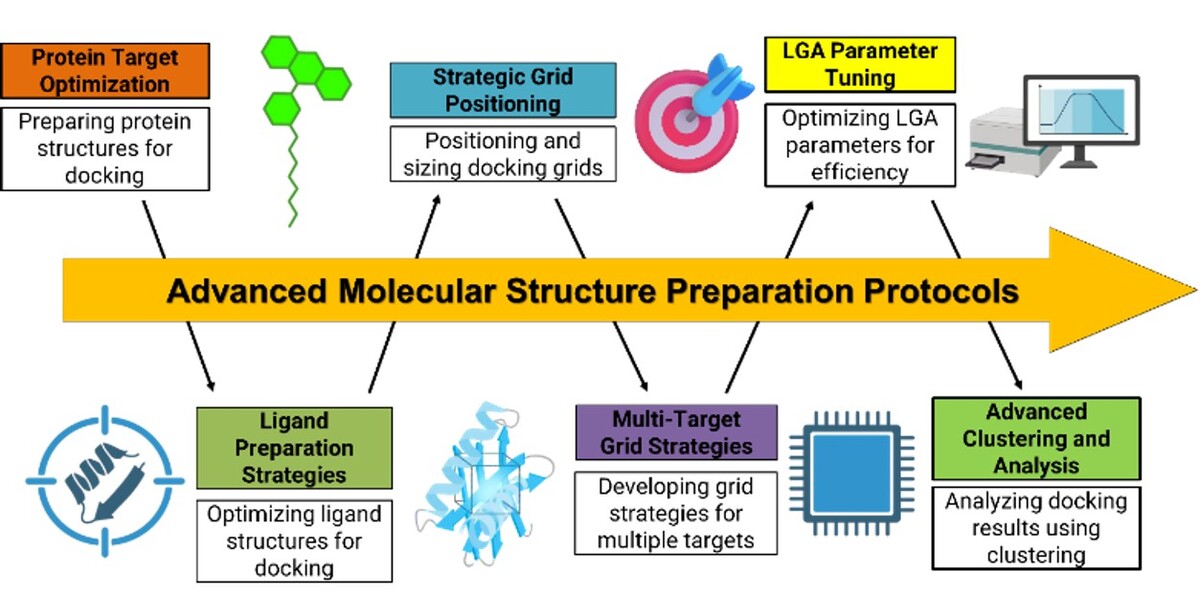
AutoDock: A Comprehensive Molecular Docking Methodology, Application Steps, and High-Accuracy Screening Approach with Detailed Case Study
1
Department of Microbiology, Biochemistry and Immunology, Morehouse School of Medicine, Atlanta, USA-30210
Submission date: 2025-08-25
Final revision date: 2025-09-15
Acceptance date: 2025-09-24
Online publication date: 2026-01-28
Publication date: 2026-01-28
Corresponding author
Ramar Vanajothi
Department of Microbiology, Biochemistry and Immunology, Morehouse School of Medicine, Atlanta, USA-30210
Department of Microbiology, Biochemistry and Immunology, Morehouse School of Medicine, Atlanta, USA-30210
Journal of Medico Informatics 2026;02(Issue 01):24-30
HIGHLIGHTS
- AutoDock enables accurate prediction of protein–ligand interactions in drug discovery.
- Grid-based energy calculations improve docking speed and computational efficiency.
- Lamarckian Genetic Algorithm optimizes ligand conformations and binding affinity predictions.
- Case study demonstrates successful BACE1 inhibitor docking with high accuracy.
- GPU acceleration and machine learning enhance modern AutoDock virtual screening performance.
KEYWORDS
TOPICS
ABSTRACT
Autodock is one of the leading and widely used computational tools for molecular docking, majorly played a role in structure-based drug discovery to predict the molecular interactions of small molecules with biological targets. Methodology of Autodock starts with generation of grid-based energy calculation system, which precomputes molecular interaction energies between biological targets and small molecules especially in the protein’s binding sites. AutoDock provides a semi-empirical free energy force field which accounting a van der Waals, hydrogen bonding, electrostatic, desolvation and conformational entropy effects calibrated against experimental data for high predictive accuracy. The screening of optimal ligand poses is predicted with advanced algorithms, like the Lamarckian Genetic Algorithm, which combines both global and local refinement to identify energetically favourable binding modes. In the current study, we exemplify the BACE1 (Beta-site amyloid precursor protein cleaving enzyme 1) a critical drug target in Alzheimer's disease reaching using Autodock, with known small molecule inhibitors was redocked successfully to reproduce the experimental binding mode with sub-2Å RMSD accuracy and offering thorough energetic insights. Such applications demonstrate AutoDOCK’s ability to reliably identify the rank of potential inhibitors, discover novel chemotypes and support virtual screening campaigns with high enrichment rates. The incorporation of GPU acceleration, machine learning applications with enhanced scoring and flexibility in the receptor selection protocols extends the utilization of AutoDock more effectively and making it cornerstone technology for high-accuracy molecular screening in modern drug discovery pipelines.
ACKNOWLEDGEMENTS
Not Applicable
FUNDING
No funding was reported with this study
CONFLICT OF INTEREST
The authors declare that they have no known financial, personal, academic, or other relationships that could inappropriately influence, or be perceived to influence, the work reported in this manuscript. All authors confirm that there are no competing interests to declare.
PEER REVIEW INFORMATION
Article has been screened for originality
© 2026 The Authors. Published by Aayvu Publications Private Limited under CC BY 4.0.
REFERENCES (31)
1.
Azad I, Khan T, Ahmad N, Khan AR, Akhter Y. (2023), Updates on drug designing approach through computational strategies: a review, Future Sci OA, 9(5):FSO862. doi:10.2144/fsoa-2022-0085. PMID: 37180609.
2.
Bender BJ, Gahbauer S, Luttens A, Lyu J, Webb CM, Stein RM, Fink EA, Balius TE, Carlsson J, Irwin JJ, Shoichet BK. (2021), A practical guide to large-scale docking, Nat Protoc, 16(10):4799-4832. doi:10.1038/s41596-021-00597-z. PMID: 34561691.
3.
Bianco G, Forli S, Goodsell DS, Olson AJ. (2016), Covalent docking using autodock: Two-point attractor and flexible side chain methods, Protein Sci, 25(1):295-301. doi:10.1002/pro.2733. PMID: 26103917.
4.
Blanes-Mira C, Fernandez-Aguado P, de Andres-Lopez J, Fernandez-Carvajal A, Ferrer-Montiel A, Fernandez-Ballester G. (2022), Comprehensive Survey of Consensus Docking for High-Throughput Virtual Screening, Molecules, 28(1) doi:10.3390/molecules28010175. PMID: 36615367.
5.
Chang Y, Hawkins BA, Du JJ, Groundwater PW, Hibbs DE, Lai F. (2022), A Guide to In Silico Drug Design, Pharmaceutics, 15(1) doi:10.3390/pharmaceutics15010049. PMID: 36678678.
6.
Cosconati S, Forli S, Perryman AL, Harris R, Goodsell DS, Olson AJ. (2010), Virtual Screening with AutoDock: Theory and Practice, Expert Opin Drug Discov, 5(6):597-607. doi:10.1517/17460441.2010.484460. PMID: 21532931.
7.
Dias DA, Urban S, Roessner U. (2012), A historical overview of natural products in drug discovery, Metabolites, 2(2):303-36. doi:10.3390/metabo2020303. PMID: 24957513.
8.
Eberhardt J, Santos-Martins D, Tillack AF, Forli S. (2021), AutoDock Vina 1.2.0: New Docking Methods, Expanded Force Field, and Python Bindings, J Chem Inf Model, 61(8):3891-3898. doi:10.1021/acs.jcim.1c00203. PMID: 34278794.
9.
Forli S, Huey R, Pique ME, Sanner MF, Goodsell DS, Olson AJ. (2016), Computational protein-ligand docking and virtual drug screening with the AutoDock suite, Nat Protoc, 11(5):905-19. doi:10.1038/nprot.2016.051. PMID: 27077332.
10.
Fuhrmann J, Rurainski A, Lenhof HP, Neumann D. (2010), A new Lamarckian genetic algorithm for flexible ligand-receptor docking, J Comput Chem, 31(9):1911-8. doi:10.1002/jcc.21478. PMID: 20082382.
11.
Guan B, Zhang C, Zhao Y. (2017), HIGA: A Running History Information Guided Genetic Algorithm for Protein-Ligand Docking, Molecules, 22(12) doi:10.3390/molecules22122233. PMID: 29244750.
12.
Guo Z, Li B, Cheng LT, Zhou S, McCammon JA, Che J. (2015), Identification of protein-ligand binding sites by the level-set variational implicit-solvent approach, J Chem Theory Comput, 11(2):753-65. doi:10.1021/ct500867u. PMID: 25941465.
13.
Helgren TR, Hagen TJ. (2017), Demonstration of AutoDock as an Educational Tool for Drug Discovery, J Chem Educ, 94(3):345-349. doi:10.1021/acs.jchemed.6b00555. PMID: 28670004.
14.
Herrera-Acevedo C, Flores-Gaspar A, Scotti L, Mendonca-Junior FJB, Scotti MT, Coy-Barrera E. (2021), Identification of Kaurane-Type Diterpenes as Inhibitors of Leishmania Pteridine Reductase I, Molecules, 26(11) doi:10.3390/molecules26113076. PMID: 34063939.
15.
Hu B, Lill MA. (2013), Exploring the potential of protein-based pharmacophore models in ligand pose prediction and ranking, J Chem Inf Model, 53(5):1179-90. doi:10.1021/ci400143r. PMID: 23621564.
16.
Klebe G. (2006), Virtual ligand screening: strategies, perspectives and limitations, Drug Discov Today, 11(13-14):580-94. doi:10.1016/j.drudis.2006.05.012. PMID: 16793526.
17.
Kovacikova L, Prnova MS, Majekova M, Bohac A, Karasu C, Stefek M. (2021), Development of Novel Indole-Based Bifunctional Aldose Reductase Inhibitors/Antioxidants as Promising Drugs for the Treatment of Diabetic Complications, Molecules, 26(10) doi:10.3390/molecules26102867. PMID: 34066081.
18.
Lexa KW, Carlson HA. (2012), Protein flexibility in docking and surface mapping, Q Rev Biophys, 45(3):301-43. doi:10.1017/S0033583512000066. PMID: 22569329.
19.
Marques L, Costa B, Pereira M, Silva A, Santos J, Saldanha L, Silva I, Magalhaes P, Schmidt S, Vale N. (2024), Advancing Precision Medicine: A Review of Innovative In Silico Approaches for Drug Development, Clinical Pharmacology and Personalized Healthcare, Pharmaceutics, 16(3) doi:10.3390/pharmaceutics16030332. PMID: 38543226.
20.
Meng XY, Zhang HX, Mezei M, Cui M. (2011), Molecular docking: a powerful approach for structure-based drug discovery, Curr Comput Aided Drug Des, 7(2):146-57. doi:10.2174/157340911795677602. PMID: 21534921.
21.
Mukherjee S, Balius TE, Rizzo RC. (2010), Docking validation resources: protein family and ligand flexibility experiments, J Chem Inf Model, 50(11):1986-2000. doi:10.1021/ci1001982. PMID: 21033739.
22.
Ni B, Wang H, Khalaf HKS, Blay V, Houston DR. (2024), AutoDock-SS: AutoDock for Multiconformational Ligand-Based Virtual Screening, J Chem Inf Model, 64(9):3779-3789. doi:10.1021/acs.jcim.4c00136. PMID: 38624083.
23.
Okafor SN, Angsantikul P, Ahmed H. (2022), Discovery of Novel HIV Protease Inhibitors Using Modern Computational Techniques, Int J Mol Sci, 23(20) doi:10.3390/ijms232012149. PMID: 36293006.
24.
Ravindranath PA, Forli S, Goodsell DS, Olson AJ, Sanner MF. (2015), AutoDockFR: Advances in Protein-Ligand Docking with Explicitly Specified Binding Site Flexibility, PLoS Comput Biol, 11(12):e1004586. doi:10.1371/journal.pcbi.1004586. PMID: 26629955.
25.
Reis P, Bertolini M, Montanari F, Rocchia W, Machuqueiro M, Clevert DA. (2022), A Fast and Interpretable Deep Learning Approach for Accurate Electrostatics-Driven pK(a) Predictions in Proteins, J Chem Theory Comput, 18(8):5068-5078. doi:10.1021/acs.jctc.2c00308. PMID: 35837736.
26.
Santos-Martins D, Solis-Vasquez L, Tillack AF, Sanner MF, Koch A, Forli S. (2021), Accelerating AutoDock4 with GPUs and Gradient-Based Local Search, J Chem Theory Comput, 17(2):1060-1073. doi:10.1021/acs.jctc.0c01006. PMID: 33403848.
27.
Serrano DR, Luciano FC, Anaya BJ, Ongoren B, Kara A, Molina G, Ramirez BI, Sanchez-Guirales SA, Simon JA, Tomietto G, Rapti C, Ruiz HK, Rawat S, Kumar D, Lalatsa A. (2024), Artificial Intelligence (AI) Applications in Drug Discovery and Drug Delivery: Revolutionizing Personalized Medicine, Pharmaceutics, 16(10) doi:10.3390/pharmaceutics16101328. PMID: 39458657.
28.
Trott O, Olson AJ. (2010), AutoDock Vina: improving the speed and accuracy of docking with a new scoring function, efficient optimization, and multithreading, J Comput Chem, 31(2):455-61. doi:10.1002/jcc.21334. PMID: 19499576.
29.
Wu K, Karapetyan E, Schloss J, Vadgama J, Wu Y. (2023), Advancements in small molecule drug design: A structural perspective, Drug Discov Today, 28(10):103730. doi:10.1016/j.drudis.2023.103730. PMID: 37536390.
30.
Xia S, Chen E, Zhang Y. (2023), Integrated Molecular Modeling and Machine Learning for Drug Design, J Chem Theory Comput, 19(21):7478-7495. doi:10.1021/acs.jctc.3c00814. PMID: 37883810.
31.
Zhao J, Fu Y, Yasvoina M, Shao P, Hitt B, O'Connor T, Logan S, Maus E, Citron M, Berry R, Binder L, Vassar R. (2007), Beta-site amyloid precursor protein cleaving enzyme 1 levels become elevated in neurons around amyloid plaques: implications for Alzheimer's disease pathogenesis, J Neurosci, 27(14):3639-49. doi:10.1523/JNEUROSCI.4396-06.2007. PMID: 17409228.
Share
RELATED ARTICLE
| ISSN: | 3108-2696 |

We process personal data collected when visiting the website. The function of obtaining information about users and their behavior is carried out by voluntarily entered information in forms and saving cookies in end devices. Data, including cookies, are used to provide services, improve the user experience and to analyze the traffic in accordance with the Privacy policy. Data are also collected and processed by Google Analytics tool (more).
You can change cookies settings in your browser. Restricted use of cookies in the browser configuration may affect some functionalities of the website.
You can change cookies settings in your browser. Restricted use of cookies in the browser configuration may affect some functionalities of the website.