
RESEARCH PAPER
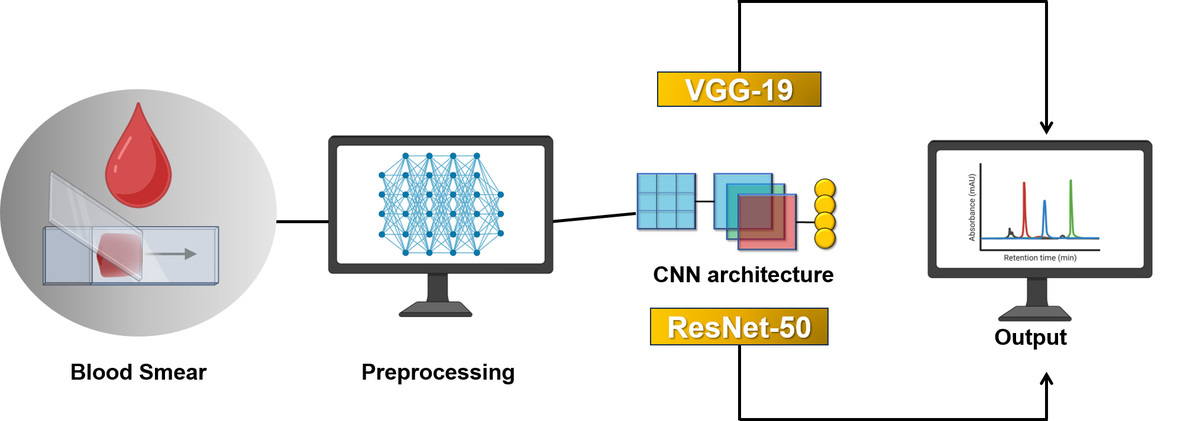
Automated Malaria Diagnosis from Blood Smear Images Using Fine-Tuned VGG-19 and ResNet50 Models
1
Department of Medicine, Henry Ford Health, Detroit, MI, United States of America
Submission date: 2025-08-25
Final revision date: 2025-09-09
Acceptance date: 2025-09-15
Online publication date: 2026-01-28
Publication date: 2026-01-28
Corresponding author
Journal of Medico Informatics 2026;02(Issue 01):17-23
HIGHLIGHTS
- Deep learning models VGG-19 and ResNet50 used for automated malaria detection.
- Image preprocessing and augmentation improved model accuracy and generalization.
- Transfer learning significantly enhanced CNN performance on blood smear images.
- VGG-19 achieved highest accuracy and F1-score among tested models.
- AI-based diagnosis reduces manual microscopy and improves malaria detection efficiency.
KEYWORDS
Deep LearningTransfer LearningConvolutional Neural Networks (CNNs)Medical Image ProcessingMalaria DetectionHealthcareHealth equityPublic health
TOPICS
ABSTRACT
Accurate malaria diagnosis is essential for global health management, particularly in regions where the disease causes endemic epidemics. The conventional diagnostic approach of blood sample analysis by microscopy requires skilled assessors and is susceptible to human interpretative errors. This study employs an innovative deep learning approach that integrates the VGG-19 and ResNet50 models for the automated identification of malaria through the analysis of blood smear images. The suggested approach enhances prior research by integrating transfer learning with fine-tuning strategies, improving classification accuracy. The data collected from Kaggle is subjected to preprocessing, which includes picture scaling, noise reduction, and data augmentation to enhance generalization. Model convergence efficiency is attained using sparse categorical cross-entropy with the Adam optimizer. Early stopping prevents the model from overfitting, whereas precision, recall, F1-score, and accuracy are used for validation. VGG-19 exhibits enhanced performance after fine-tuning compared to other designs, as demonstrated by experimental data, due to its improved precision and stability. This study enhances medical AI by discovering deep learning applications for malaria detection, which reduce the need for manual diagnosis and expedite illness identification in resource-limited medical environments. Interpretability strategies enhance the clinical use of automated systems and foster confidence between healthcare practitioners and these technologies.
ACKNOWLEDGEMENTS
The author acknowledges Henry Ford Health, Department of Medicine, Detroit, MI, USA, for institutional support.
FUNDING
No funding was reported for this research work
CONFLICT OF INTEREST
The authors declare that they have no known financial, personal, academic, or other relationships that could inappropriately influence, or be perceived to influence, the work reported in this manuscript. The author confirms that there are no competing interests to declare.
PEER REVIEW INFORMATION
Article has been screened for originality
© 2026 The Authors. Published by Aayvu Publications Private Limited under CC BY 4.0.
REFERENCES (34)
1.
Afifi I, Elgendy M, Abdelfatah M, El-Sappagh S. (2025), Vision and convolutional transformers for Alzheimer's disease diagnosis: a systematic review of architectures, multimodal fusion and critical gaps, Brain Inform, 13(1):1. doi:10.1186/s40708-025-00286-7. PMID: 41405782.
2.
Ahamed MF, Nahiduzzaman M, Mahmud G, Shafi FB, Ayari MA, Khandakar A, Abdullah-Al-Wadud M, Islam SMR. (2025), Improving Malaria diagnosis through interpretable customized CNNs architectures, Sci Rep, 15(1):6484. doi:10.1038/s41598-025-90851-1. PMID: 39987229.
3.
Aksoy A. (2024), An Innovative Hybrid Model for Automatic Detection of White Blood Cells in Clinical Laboratories, Diagnostics (Basel), 14(18) doi:10.3390/diagnostics14182093. PMID: 39335772.
4.
Almadhor A, Alsubai S, Kryvinska N, Hejaili AA, Ayari M, Bouallegue B, Abbas S. (2025), Evaluating large transformer models for anomaly detection of resource-constrained IoT devices for intrusion detection system, Sci Rep, 15(1):37972. doi:10.1038/s41598-025-21826-5. PMID: 41168224.
5.
Alrashdi I. (2024), Fog-based deep learning framework for real-time pandemic screening in smart cities from multi-site tomographies, BMC Med Imaging, 24(1):123. doi:10.1186/s12880-024-01302-8. PMID: 38797827.
6.
Awe OO, Mwangi PN, Goudoungou SK, Esho RV, Oyejide OS. (2025), Explainable AI for enhanced accuracy in malaria diagnosis using ensemble machine learning models, BMC Med Inform Decis Mak, 25(1):162. doi:10.1186/s12911-025-02874-3. PMID: 40217281.
7.
Caliman Sturdza OA, Filip F, Terteliu Baitan M, Dimian M. (2025), Deep Learning Network Selection and Optimized Information Fusion for Enhanced COVID-19 Detection: A Literature Review, Diagnostics (Basel), 15(14) doi:10.3390/diagnostics15141830. PMID: 40722579.
8.
Chiu YC, Chen HH, Zhang T, Zhang S, Gorthi A, Wang LJ, Huang Y, Chen Y. (2019), Predicting drug response of tumors from integrated genomic profiles by deep neural networks, BMC Med Genomics, 12(Suppl 1):18. doi:10.1186/s12920-018-0460-9. PMID: 30704458.
9.
Chong PL, Vaigeshwari V, Mohammed Reyasudin BK, Noor Hidayah BRA, Tatchanaamoorti P, Yeow JA, Kong FY. (2025), Integrating artificial intelligence in healthcare: applications, challenges, and future directions, Future Sci OA, 11(1):2527505. doi:10.1080/20565623.2025.2527505. PMID: 40616302.
10.
Debnath K, Rana P, Ghosh P. (2025), A survey on deep learning for drug-target binding prediction: models, benchmarks, evaluation, and case studies, Brief Bioinform, 26(5) doi:10.1093/bib/bbaf491. PMID: 40977267.
11.
Dong C, Liu Y, Nie J, Zhang X, Yu F, Zhou Y. (2025), Artificial Intelligence in Infectious Disease Diagnostic Technologies, Diagnostics (Basel), 15(20) doi:10.3390/diagnostics15202602. PMID: 41153274.
12.
Farhan M, Waheed Ud Din H, Ullah S, Hussain MS, Khan MA, Mazhar T, Khattak UF, Jaghdam IH. (2025), Network-based intrusion detection using deep learning technique, Sci Rep, 15(1):25550. doi:10.1038/s41598-025-08770-0. PMID: 40664956.
13.
Ganie SM, Malik MB, Aadil M, Muteeb G, Farhan M, Aatif M. (2025), Explainable AI based hybrid DRM-Net transfer learning model for breast cancer detection and classification using ultrasound images, Sci Rep, 15(1):44170. doi:10.1038/s41598-025-27934-6. PMID: 41419544.
14.
Goceri E. (2023), Medical image data augmentation: techniques, comparisons and interpretations, Artif Intell Rev, 10.1007/s10462-023-10453-z:1-45. doi:10.1007/s10462-023-10453-z. PMID: 37362888.
15.
Goktas P, Grzybowski A. (2025), Shaping the Future of Healthcare: Ethical Clinical Challenges and Pathways to Trustworthy AI, J Clin Med, 14(5) doi:10.3390/jcm14051605. PMID: 40095575.
16.
Halloum K, Ez-Zahraouy H. (2025), Enhancing Medical Image Classification through Transfer Learning and CLAHE Optimization, Curr Med Imaging, 21:e15734056342623. doi:10.2174/0115734056342623241119061744. PMID: 40259867.
17.
Jameela T, Athotha K, Singh N, Gunjan VK, Kahali S. (2022), Deep Learning and Transfer Learning for Malaria Detection, Comput Intell Neurosci, 2022:2221728. doi:10.1155/2022/2221728. PMID: 35814548.
18.
Kandhro IA, Manickam S, Fatima K, Uddin M, Malik U, Naz A, Dandoush A. (2024), Performance evaluation of E-VGG19 model: Enhancing real-time skin cancer detection and classification, Heliyon, 10(10):e31488. doi:10.1016/j.heliyon.2024.e31488. PMID: 38826726.
19.
Karimi D, Dou H, Warfield SK, Gholipour A. (2020), Deep learning with noisy labels: Exploring techniques and remedies in medical image analysis, Med Image Anal, 65:101759. doi:10.1016/j.media.2020.101759. PMID: 32623277.
20.
Khan SH, Shah NS, Nuzhat R, Majid A, Alquhayz H, Khan A. (2022), Malaria parasite classification framework using a novel channel squeezed and boosted CNN, Microscopy (Oxf), 71(5):271-282. doi:10.1093/jmicro/dfac027. PMID: 35640304.
21.
Li C, Dai J, Tian S, Jiang Y, Hu Q, Chen J, Peng S, Wen Y. (2025), Ranking-oriented machine learning framework for probabilistic wind power forecasting with temporal reliability constraints, Sci Rep, 15(1):42125. doi:10.1038/s41598-025-26241-4. PMID: 41298734.
22.
Maturana CR, de Oliveira AD, Nadal S, Bilalli B, Serrat FZ, Soley ME, Igual ES, Bosch M, Lluch AV, Abello A, Lopez-Codina D, Sune TP, Clols ES, Joseph-Munne J. (2022), Advances and challenges in automated malaria diagnosis using digital microscopy imaging with artificial intelligence tools: A review, Front Microbiol, 13:1006659. doi:10.3389/fmicb.2022.1006659. PMID: 36458185.
23.
Mennella C, Maniscalco U, De Pietro G, Esposito M. (2024), Ethical and regulatory challenges of AI technologies in healthcare: A narrative review, Heliyon, 10(4):e26297. doi:10.1016/j.heliyon.2024.e26297. PMID: 38384518.
24.
Mustapha B, Zhou Y, Shan C, Xiao Z. (2025), Enhanced Pneumonia Detection in Chest X-Rays Using Hybrid Convolutional and Vision Transformer Networks, Curr Med Imaging, 21:e15734056326685. doi:10.2174/0115734056326685250101113959. PMID: 39806960.
25.
Obeagu EI, Ogenyi FC. (2025), Artificial intelligence in African malaria control programs: opportunities and risks, Ann Med Surg (Lond), 87(12):8664-8670. doi:10.1097/MS9.0000000000004259. PMID: 41377369.
26.
Parveen R, Qui B, Song W, Al-Kahtani N, Jamjoom MM, Mostafa SM, Sultan N, Fatima J. (2025), Trustworthy deep learning for malaria diagnosis using explainable artificial intelligence, Sci Rep, 15(1):45037. doi:10.1038/s41598-025-28387-7. PMID: 41419508.
27.
Rajpal S, Lakhyani N, Singh AK, Kohli R, Kumar N. (2021), Using handpicked features in conjunction with ResNet-50 for improved detection of COVID-19 from chest X-ray images, Chaos Solitons Fractals, 145:110749. doi:10.1016/j.chaos.2021.110749. PMID: 33589854.
28.
Sallam M, Al-Khatib AO, Al-Mahzoum KS, Abdelaziz DH, Sallam M. (2025), Current Developments in Malaria Vaccination: A Concise Review on Implementation, Challenges, and Future Directions, Clin Pharmacol, 17:29-47. doi:10.2147/CPAA.S513282. PMID: 40191019.
29.
Satpathy S, Tripathy U, Swain PK. (2025), Cloud-based DDoS detection using hybrid feature selection with deep reinforcement learning (DRL), Sci Rep, 15(1):36546. doi:10.1038/s41598-025-18857-3. PMID: 41120397.
30.
Sebastian N, Ankayarkanni B. (2025), Enhanced ResNet-50 with Multi-Feature Fusion for Robust Detection of Pneumonia in Chest X-Ray Images, Diagnostics (Basel), 15(16) doi:10.3390/diagnostics15162041. PMID: 40870892.
31.
Sivakumar M, Parthasarathy S, Padmapriya T. (2024), Trade-off between training and testing ratio in machine learning for medical image processing, PeerJ Comput Sci, 10:e2245. doi:10.7717/peerj-cs.2245. PMID: 39314694.
32.
Sluijterman L, Cator E, Heskes T. (2024), How to evaluate uncertainty estimates in machine learning for regression?, Neural Netw, 173:106203. doi:10.1016/j.neunet.2024.106203. PMID: 38442649.
33.
Ur Rehman S, Damasevicius R, Al Sukhni H, Aljohani A, Hamza A, Mohammed Alsekait D, AbdElminaam DS. (2025), A novel deep learning based approach with hyperparameter selection using grey wolf optimization for leukemia classification and hematologic malignancy detection, PeerJ Comput Sci, 11:e3160. doi:10.7717/peerj-cs.3160. PMID: 40989368.
34.
Wang G, Luo G, Lian H, Chen L, Wu W, Liu H. (2023), Application of Deep Learning in Clinical Settings for Detecting and Classifying Malaria Parasites in Thin Blood Smears, Open Forum Infect Dis, 10(11):ofad469. doi:10.1093/ofid/ofad469. PMID: 37937045.
Share
RELATED ARTICLE
| ISSN: | 3108-2696 |

We process personal data collected when visiting the website. The function of obtaining information about users and their behavior is carried out by voluntarily entered information in forms and saving cookies in end devices. Data, including cookies, are used to provide services, improve the user experience and to analyze the traffic in accordance with the Privacy policy. Data are also collected and processed by Google Analytics tool (more).
You can change cookies settings in your browser. Restricted use of cookies in the browser configuration may affect some functionalities of the website.
You can change cookies settings in your browser. Restricted use of cookies in the browser configuration may affect some functionalities of the website.